
Introduction
Do you ever ask yourself why certain sites reliably show up at the very top of Google results, while others can’t break onto page one? In many cases, the reason is not limited to keyword choices or links pointing in. These days, Google gives considerable weight to how strong, reliable, and dependable the material you post appears. That’s exactly the role E-E-A-T serves.
No matter if you run a company site, oversee an online shop, or post articles often, knowing what E-E-A-T involves can meaningfully shift your SEO outcomes. When you publish material that shows real know-how and earns reader confidence, you raise the likelihood of better placement and of reaching the audience you want.
Quick Answer Summary
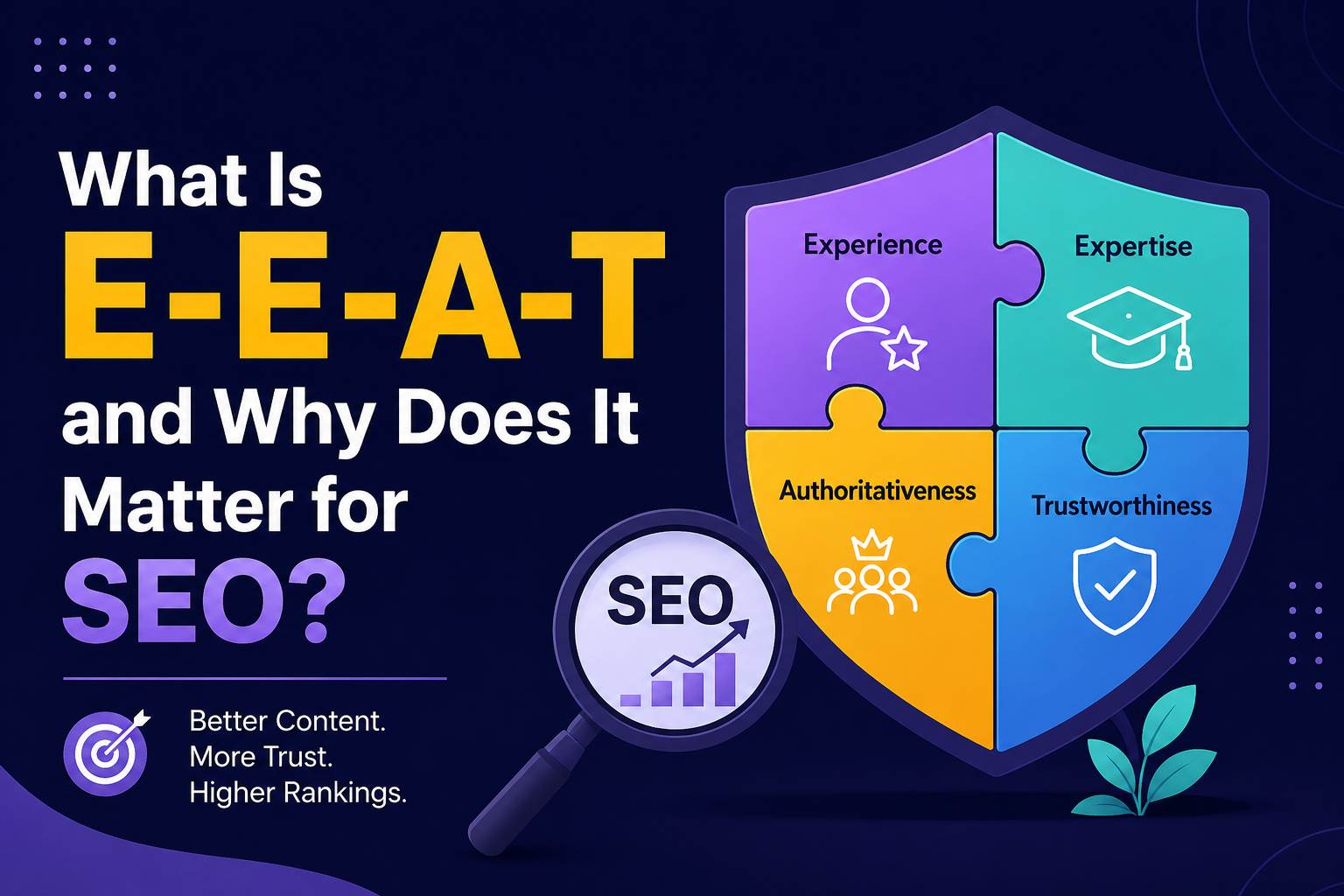
The acronym E-E-A-T refers to Experience, Expertise, Authoritativeness, and Trustworthiness. Google’s Search Quality Evaluators use it as a set of criteria for judging overall web-content quality. Even though E-E-A-T is not itself a direct signal in rankings, sites that repeatedly show these traits usually have a better chance of doing well in search.
To strengthen E-E-A-T, companies should:
- Offer genuine first-hand experience.
- Release content written by qualified experts.
- Grow authority by earning strong links and being cited.
- Make the site open, clear, and confidence-building.
- Ensure information is correct and refreshed often.
Detailed Explanation
What Does E-E-A-T Mean?
To better surface content that truly benefits people, Google brought in E-E-A-T as a guideline. Each component is easier to grasp when viewed on its own.
1. Experience
In this context, experience means direct exposure to a subject or hands-on participation in it. Google prefers material produced by someone who has truly tried the product, gone to the location, or carried out the work.
As an illustration, someone discussing Website Development Services after leading several web builds will usually be more useful than a writer who only rephrases what they’ve read elsewhere.
Your work becomes stronger when you add personal takeaways, project stories, images of results, and other authentic proof.
2. Expertise
Expertise is about the depth of understanding the writer has in a given area.
When the topic involves money, medicine, law, or technical SEO, audiences generally look for guidance from trained professionals or seasoned practitioners.
Companies may show expertise by:
- Creating thoroughly researched pieces
- Adding writer bios
- Citing dependable references
- Going into depth rather than staying shallow
As expertise rises, readers tend to feel more certain about what you’re telling them.
3. Authoritativeness
Authoritativeness grows when others treat your site as a dependable place to get information.
Google looks at signals such as:
- Strong, reputable inbound links
- Mentions of your brand
- A favorable digital reputation
- Recognition within the field
- Feedback from customers
Regularly delivering high-value material also supports lasting authority in your niche over time.
For example, when your business frequently publishes useful posts about Digital Marketing Services, both readers and other sites become more inclined to cite what you’ve produced.
4. Trustworthiness
Within E-E-A-T, trust is viewed as the key pillar.
When a site is trustworthy, visitors feel safe and assured while using it.
Trust can be raised by:
- Implementing HTTPS
- Making contact details easy to find
- Sharing clear privacy practices
- Featuring customer feedback
- Keeping details correct and current
- Steering clear of deceptive titles
If trust is missing, even content that seems authoritative can have a hard time performing.n authoritative content may struggle to perform well.
Why Is E-E-A-T Important for SEO?
Google aims above all to give searchers answers they can rely on.
Sites that show solid E-E-A-T commonly gain multiple SEO advantages:
Better Search Rankings–
Even though E-E-A-T is not a ranking signal on its own, it affects various signals Google uses when judging quality.
Improved User Experience-
People spend more time on pages that deliver information that is accurate, helpful, and dependable.
That can lift engagement measures such as:
- Time spent on a page
- Bounce rates
- Repeat visitors
Higher Conversion Rates-
People are more inclined to buy or to ask about services when they believe the business is reliable.
A site that feels credible typically turns more visitors into buyers.
Increased Brand Reputation-
When you regularly publish knowledgeable material, your business can be seen as a leader in the space, which encourages people to come back whenever they need information they can trust.
Common Mistakes That Hurt E-E-A-T
A lot of sites reduce their E-E-A-T without realizing it by making preventable errors like:
- Posting AI-created text with no human check
- Leaving old details in place
- Relying on sensational titles
- Reusing competitor material
- Keeping contact information hidden
- Overlooking reviews from customers
- Failing to refresh older posts
- Sharing pieces with no author details
Fixing these problems can greatly increase how credible your site appears.
Step-by-Step Process to Improve E-E-A-T
Step 1: Publish Original Content
Prioritize producing unique material grounded in real experience, solid research, and hands-on understanding, rather than reworking what already exists online.
Step 2: Showcase Author Expertise
Add writer names, relevant qualifications, and brief bios so readers can see why the author is credible.
Step 3: Keep Content Updated
Revisit older posts on a routine basis and update figures, images, examples, and shifts in the industry.
Step 4: Build High-Quality Backlinks
Attract links in an organic way by publishing resources that others genuinely want to cite.
Over time, strong SEO Services may also support growth in your site’s authority.
Step 5: Strengthen Website Trust
Make sure your site provides:
- HTTPS via SSL
- A page for contacting you
- An About Us section
- A Privacy Policy
- Terms and conditions
- Real customer endorsements
Step 6: Create Helpful User-Focused Content
Rather than writing mainly to satisfy algorithms, aim to address real user needs with thorough, accurate, and clear information. Google tends to favor pages that truly assist users and respond to questions in a straightforward way.
With more people using voice assistants to search, writing in a natural, conversation-like, user-first style can further reinforce E-E-A-T. For more details, see our Voice Search SEO: How to Optimise Your Website guide, which outlines how voice-search work supports an overall SEO approach.
FAQs
What does E-E-A-T stand for?
E-E-A-T means Experience, Expertise, Authoritativeness, and Trustworthiness.
Is E-E-A-T a Google ranking factor?
No. It isn’t a direct ranking factor, but it shapes many quality-related signals that influence where pages appear.
Which websites benefit the most from E-E-A-T?
Every site can gain from E-E-A-T, with especially strong impact for business sites, online stores, health and medical pages, finance-related sites, legal providers, learning platforms, and blogs.
How can I improve my website’s E-E-A-T?
Raise E-E-A-T by publishing content created by experts, sharing real experience, gaining strong backlinks, updating pages often, and being transparent throughout the site.
Does E-E-A-T help local SEO?
Yes. Companies that show strong credibility, receive good reviews, keep business details consistent, and publish trustworthy material often rank better in local results.
Conclusion
With Google’s ranking systems constantly changing, it matters more than ever to produce material that is correct, dependable, and truly useful. Rather than prioritizing rank-chasing, E-E-A-T pushes companies to concentrate on providing genuine benefit.
If you prove hands-on knowledge, highlight subject mastery, develop credibility, and gain audience trust, your site can perform better in search while also boosting user assurance. Paired with solid Content Marketing, strong Technical SEO, effective On-Page SEO, and a cohesive SEO Strategy, E-E-A-T serves as a robust base for lasting organic progress.